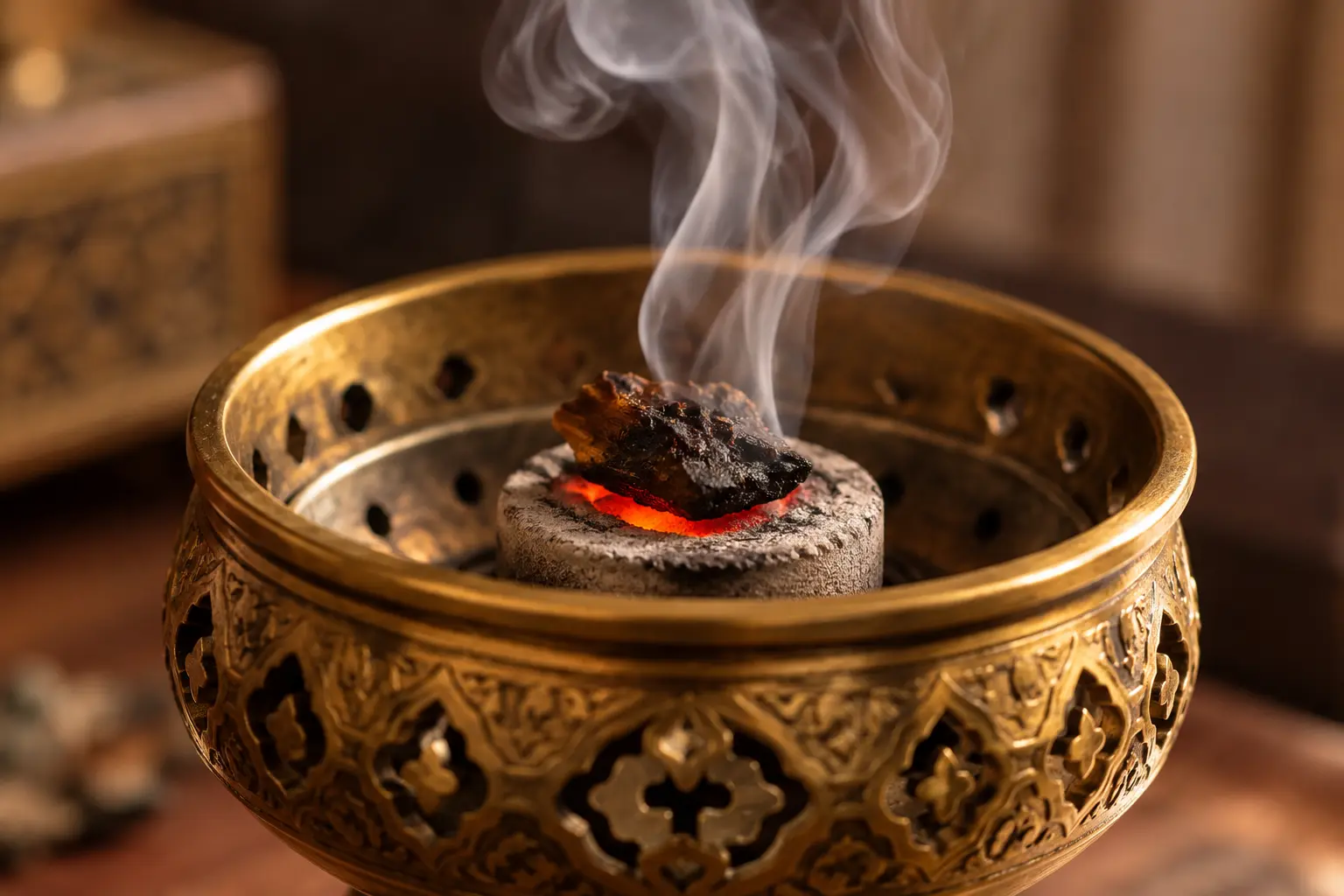
Most first attempts go the same way. Too much bakhoor, a room full of smoke, a coughing relative and a smell that somehow feels harsh instead of sweet.
Learning how to use bakhoor properly fixes all of that. A small piece, the right heat and a little patience turn the same chips into a soft, lingering scent. This guide walks you through the charcoal method, the electric method and the low smoke options, plus how to scent clothes and hair safely.
How to use bakhoor: Place a small piece of bakhoor on a heat source and let it smoulder. On charcoal, light a disc, wait until it glows evenly, then add the bakhoor. On an electric burner, switch it on, let the plate warm, then add a piece. Keep a window open and never leave it unattended.
What Do You Need to Use Bakhoor?
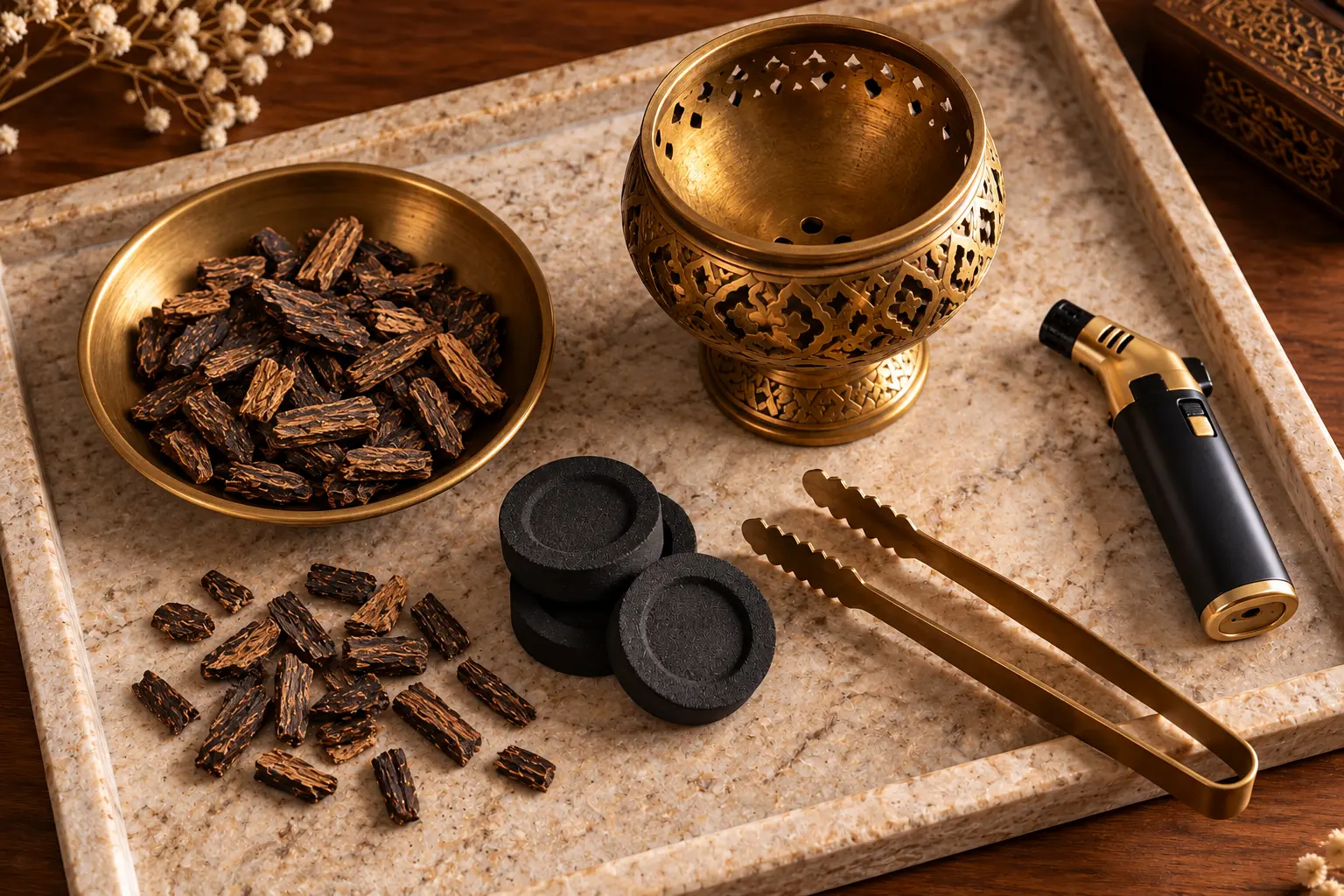
To learn how to use bakhoor, you need three things: the bakhoor itself, a heat source and a heatproof burner. Everything else is optional.
- Bakhoor. Chips, pressed tablets or plain oud wood.
- A burner. A traditional mabkhara for charcoal, or an electric bakhoor burner.
- Charcoal discs, if you are using the charcoal method.
- A lighter or matches, and a pair of tongs to handle hot charcoal.
- A heatproof surface, such as a tile, stone coaster or metal tray.
Not sure which burner suits you? Our bakhoor burner guide compares charcoal, electric and tea light types.
Mabkhara: the traditional Arabic burner for bakhoor, usually a footed bowl that holds a hot charcoal disc.
How to Use Bakhoor on Charcoal?
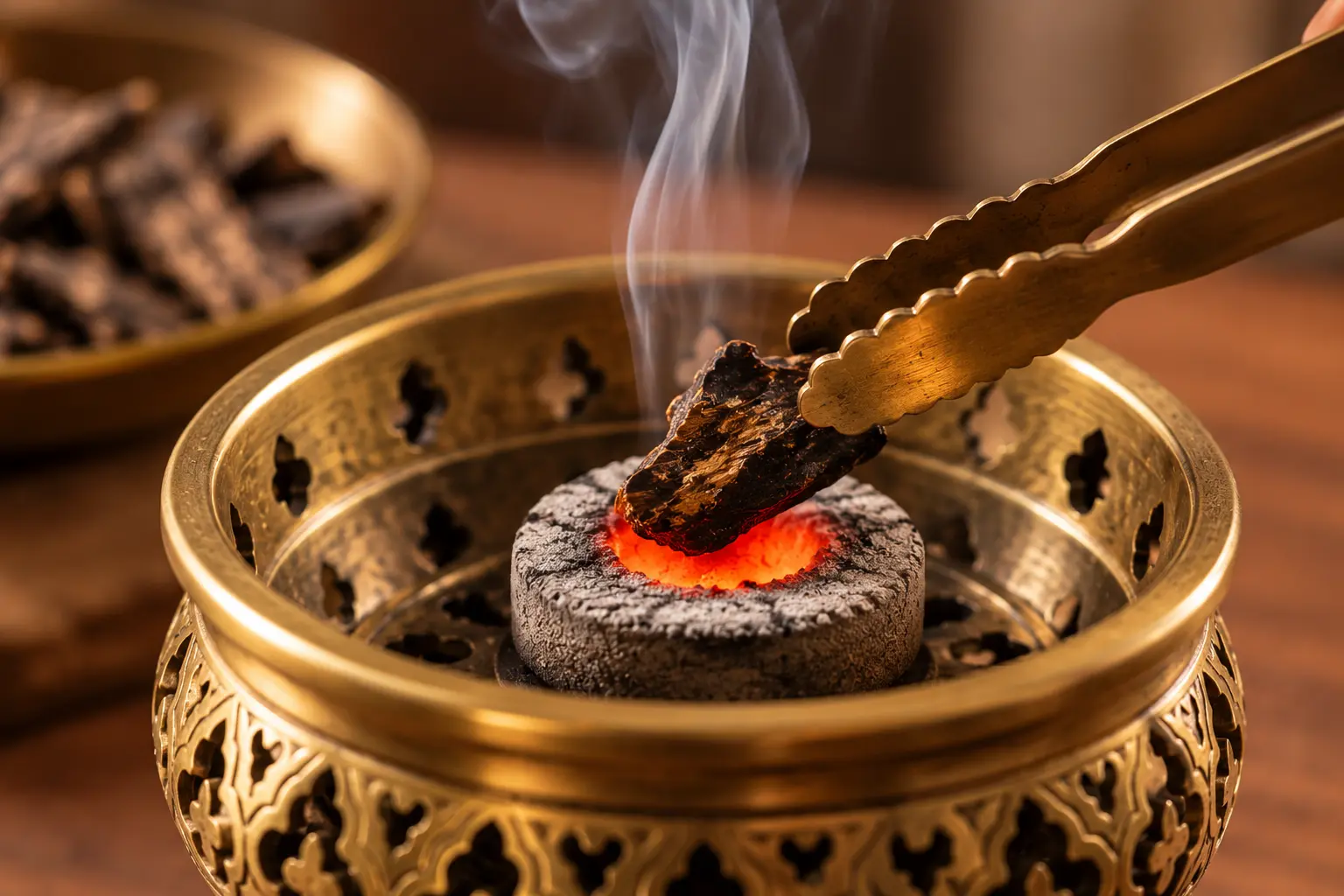
Using bakhoor on charcoal means letting a glowing disc do the heating. It is the classic answer to how to use bakhoor in the Gulf. It takes a few minutes longer than electric, but it gives the fullest, most traditional scent.
- Set up. Place your burner on a heatproof surface near an open window, away from curtains.
- Light the charcoal. Hold one small charcoal disc with tongs and light its edge. Most incense charcoal sparks and crackles as the flame spreads.
- Put it in the burner. Once it has caught, set the disc in the burner’s bowl.
- Wait for an even glow. Give it a minute or two until it stops sparking and glows steadily. Some people wait a little longer until a light grey coating forms.
- Add the bakhoor. Place one small piece, about the size of a fingernail, on the disc.
- Enjoy the smoke. Let it drift through the room, or carry the burner from room to room.
- Put it out safely. Let the charcoal burn out completely and cool before you throw it away.
Charcoal disc: a small, round, quick lighting block of charcoal made for burning incense and resins. It is not the same as barbecue charcoal.
Tip: If the smoke feels harsh, the charcoal may be too hot. Many people move the bakhoor to the cooler edge of the disc so it smoulders gently instead of scorching.
How to Use Bakhoor on an Electric Burner?
Using bakhoor on an electric burner is the easiest method. There is no charcoal, no lighter and far less smoke.
- Place the burner on a flat surface near a plug point, away from anything that can catch heat.
- Switch it on and choose a medium setting if your burner has one.
- Let the plate warm up. This usually takes a short while; check your burner’s instructions.
- Add a small piece of bakhoor to the centre of the plate.
- Adjust the heat. Turn it down if the smoke is heavy, or up if you can barely smell anything.
- Switch it off when you are done, and let the plate cool before cleaning.
If you only learn one way of how to use bakhoor, make it this one. The heat on an electric burner is lower and steadier, so the scent comes out more slowly. That makes it a good choice for flats, AC rooms, offices and daily use.
| Charcoal | Electric | |
|---|---|---|
| Set up time | A few minutes | Very quick |
| Scent strength | Richest | Softer, steadier |
| Smoke | More | Less |
| Clean up | Ash and charcoal | Wipe the plate |
| Best for | Festivals, guests, scenting clothes | Everyday use, small spaces |
Is There a Smokeless Way to Use Bakhoor?
Honestly, no. Bakhoor works by releasing scented smoke, so any method that heats it will make some. What you can do is keep the smoke very low.
The options below range from least smoke to none:
- An electric burner on its lowest setting. The bakhoor warms gently, giving a light haze rather than thick smoke.
- A tea light burner. A small candle warms a dish above it, for a soft scent in a small room.
- Scented oils instead of smoke. Many people dab oud or rose oil on a cotton ball or fabric for a similar fragrance with no smoke at all.
If smoke is a real concern at home, the honest answer is to burn less often, for shorter sessions, in a well ventilated room.
How Much Bakhoor Should You Use?
One small piece is enough for most rooms. Quantity is the part of how to use bakhoor that most beginners get wrong. A chip roughly the size of your fingernail is a good starting point.
It is easy to overdo it. Bakhoor is concentrated, and adding more rarely means more fragrance; it usually just means more smoke. Start with one piece, wait a few minutes, and only add another if the room still feels bare.
Larger spaces, like a hall prepared for guests, may need a second piece or a burner carried slowly from room to room. A small bedroom or bathroom often needs less than you think.
How to Use Bakhoor to Scent Clothes?
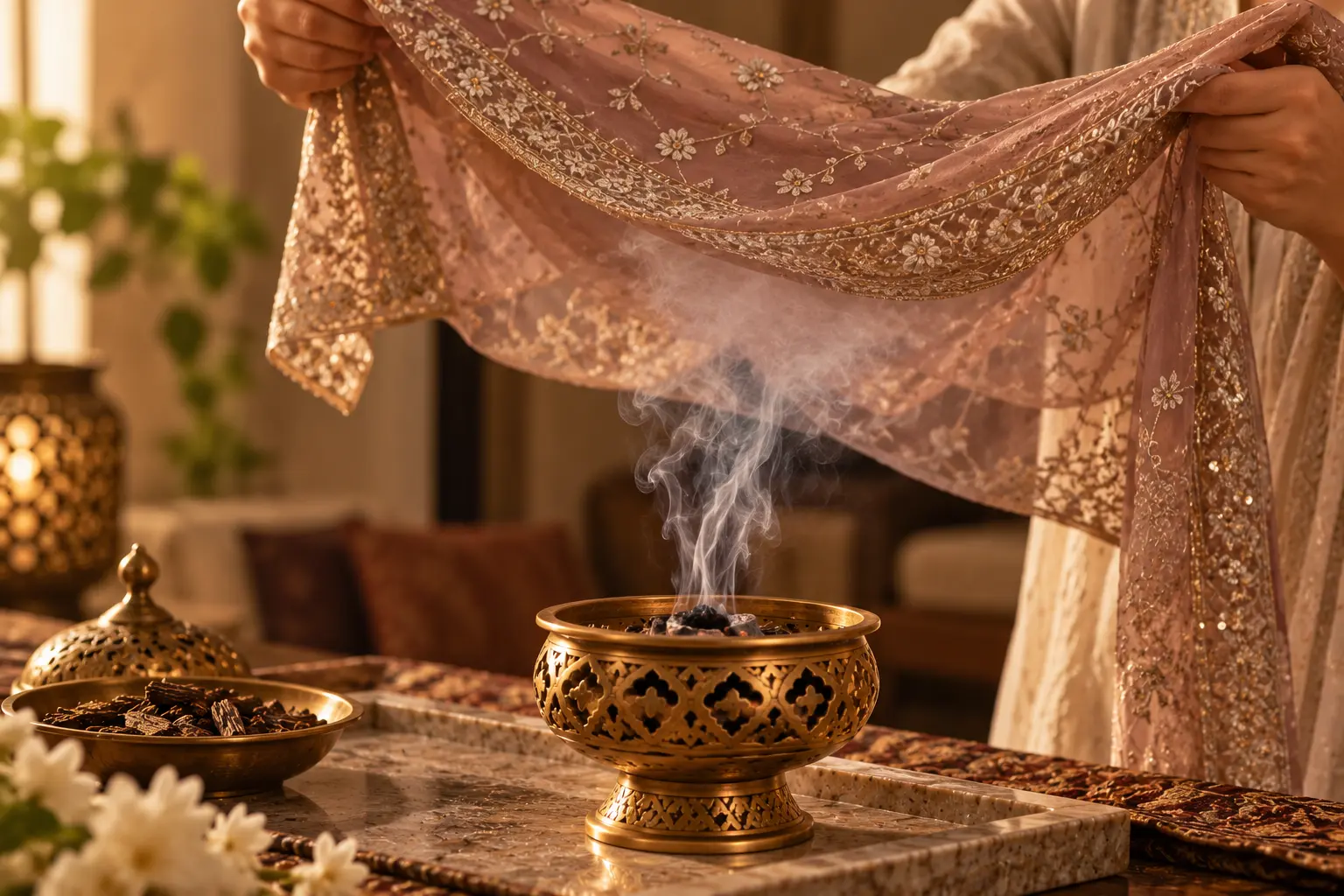
To scent clothes with bakhoor, hold the fabric above the smoke, not in it. This is one of the most loved uses of bakhoor in the Gulf, where people perfume an abaya or kandura before going out.
- Light the bakhoor in a burner with handles, or place it on a stable table.
- Hold the garment a safe distance above the burner, high enough that you can comfortably keep your hand there.
- Move the fabric slowly so the smoke reaches different parts of it.
- A minute or two is usually enough.
The same works beautifully on a dupatta, a sherwani before a wedding, or sarees folded away in a cupboard. Because bakhoor smoke is oily, the scent settles into the fibres and often lasts until the next wash.
Tip: Never place fabric directly over a charcoal burner, and keep loose sleeves and long scarves well away from the heat. Silk and light fabrics can mark if held too close.
Can You Use Bakhoor on Hair?
Yes, many people do, but it needs more care than clothes.
The usual way is to let the smoke rise near your hair, not to hold your head over the burner. Some people pass the burner gently around, at a comfortable distance, for a few seconds. Others scent a scarf or hijab first and then wear it.
Keep long hair tied back and well away from charcoal. If you have a sensitive scalp, a scented scarf is the gentler route.
How Often Can You Use Bakhoor at Home?
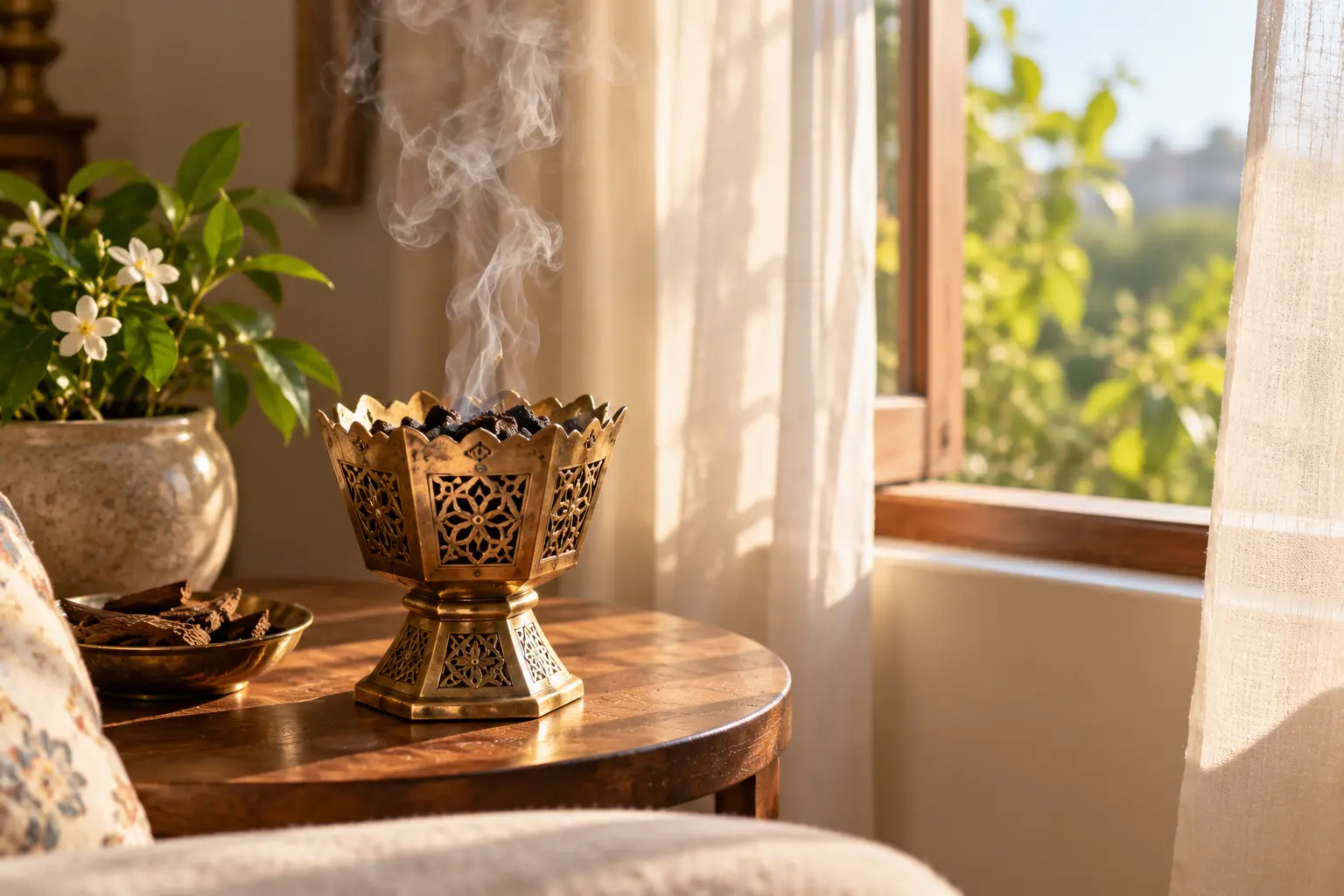
Many households use bakhoor daily, but more often isn’t always better for indoor air.
In the UAE, a 2012 study by Karin Yeatts and colleagues in Environmental Health Perspectives found that about 86% of homes burned incense at least weekly, and the UNC team reported that homes burning it more often had higher levels of formaldehyde. Research published in 2026 in Atmospheric Chemistry and Physics also found that indoor bakhoor burning releases large amounts of ultrafine particles (2026 study).
That doesn’t mean you need to stop. It means:
- Keep sessions short, especially in small rooms.
- Ventilate during and after burning.
- Avoid burning near infants, pets, or anyone with asthma.
How to Use Bakhoor in Different Climates and Seasons?
How to use bakhoor well depends partly on the air in your home. Humidity, heat and air conditioning all change how the scent behaves.
Humid weather. During the Indian monsoon or a muggy Gulf summer, smoke hangs heavier and the scent can feel thick. Use a smaller piece and keep a fan or window open so the smoke doesn’t settle.
Dry, cool weather. In winter, from Delhi to London, rooms are often closed to keep warm. The scent travels further in dry air, but ventilation is harder. Burn for shorter sessions and open a window for a few minutes afterwards.
AC rooms. Air conditioning recirculates air, so smoke can linger. Many people burn bakhoor just before switching the AC on, or in a hallway, and let the scent drift in.
Festive seasons. Around Eid, Diwali and the winter wedding season, homes often burn bakhoor more often and for longer. That is exactly when ventilation matters most, since guests, children and elderly relatives may all be in the same room.
Tip: In a small, humid room, an electric burner on a low setting gives a cleaner scent than charcoal, which can make the air feel heavy.
What Are the Common Mistakes When Using Bakhoor?
The most common mistake is using too much. A few others come up again and again:
- Adding bakhoor before the charcoal has caught. It may smother the disc or give off harsh smoke.
- Burning in a closed room. Charcoal in an enclosed space risks carbon monoxide build up. Qatar’s Hamad Medical Corporation warned in 2018 that the gas cannot be seen or smelt, and that early signs include headache, dizziness and nausea.
- Using barbecue charcoal. It is larger, smokier and much harder to control indoors.
- Leaving it unattended. Hot charcoal can crack a burner or scorch a table.
- Throwing away warm charcoal. Always let it cool completely first.
Getting these right makes a bigger difference to the scent than buying a more expensive blend.
Frequently Asked Questions
How to use bakhoor for the first time?
Start with an electric burner if you have one, as it is simpler. Place one small piece on the warm plate and keep a window open. If you are using charcoal, light one disc, wait until it glows evenly, then add the bakhoor.
How long does a piece of bakhoor last?
A small piece usually smoulders for several minutes, depending on the blend and the heat. The scent can linger in a room for hours after the smoke clears, and in fabric until it is washed.
Can you use bakhoor without charcoal?
Yes. An electric bakhoor burner heats the bakhoor on a hot plate, so you don’t need charcoal at all. A tea light burner is another option for a gentle, low smoke scent.
How do I know when the charcoal is ready for bakhoor?
The charcoal is ready once it has fully caught, stopped sparking and glows evenly. This usually takes a minute or two. Some people prefer to wait until a light grey coating forms on the surface.
Is it safe to use bakhoor in a bedroom?
It can be, if you keep the window open, use only a small piece and never fall asleep with it burning. Avoid charcoal in a small closed bedroom, as it can build up carbon monoxide. An electric burner on low is the safer choice.
How to use bakhoor for guests?
Light the bakhoor shortly before guests arrive so the scent is fresh but the smoke has eased. In many Gulf homes, the burner is also passed around after a meal as a gesture of hospitality.
Can I reuse bakhoor that didn’t burn fully?
Often you can. If a piece is only partly used, let it cool and keep it in a closed container. It may smell slightly weaker the second time.
How to use bakhoor in a wardrobe?
Light the bakhoor, open the wardrobe doors and let the smoke drift in for a minute or two, keeping the burner well away from the clothes. Close the doors afterwards so the scent stays inside.
Ready to Use Bakhoor at Home?
Once you know how to use bakhoor, the method is simple. One small piece, steady heat, an open window and someone keeping an eye on it.
Start with whichever method fits your home, then experiment with blends. If you are curious about what makes oud so special, our oud bakhoor guide explains it, and our beginner’s guide covers the basics.
Leave a Reply