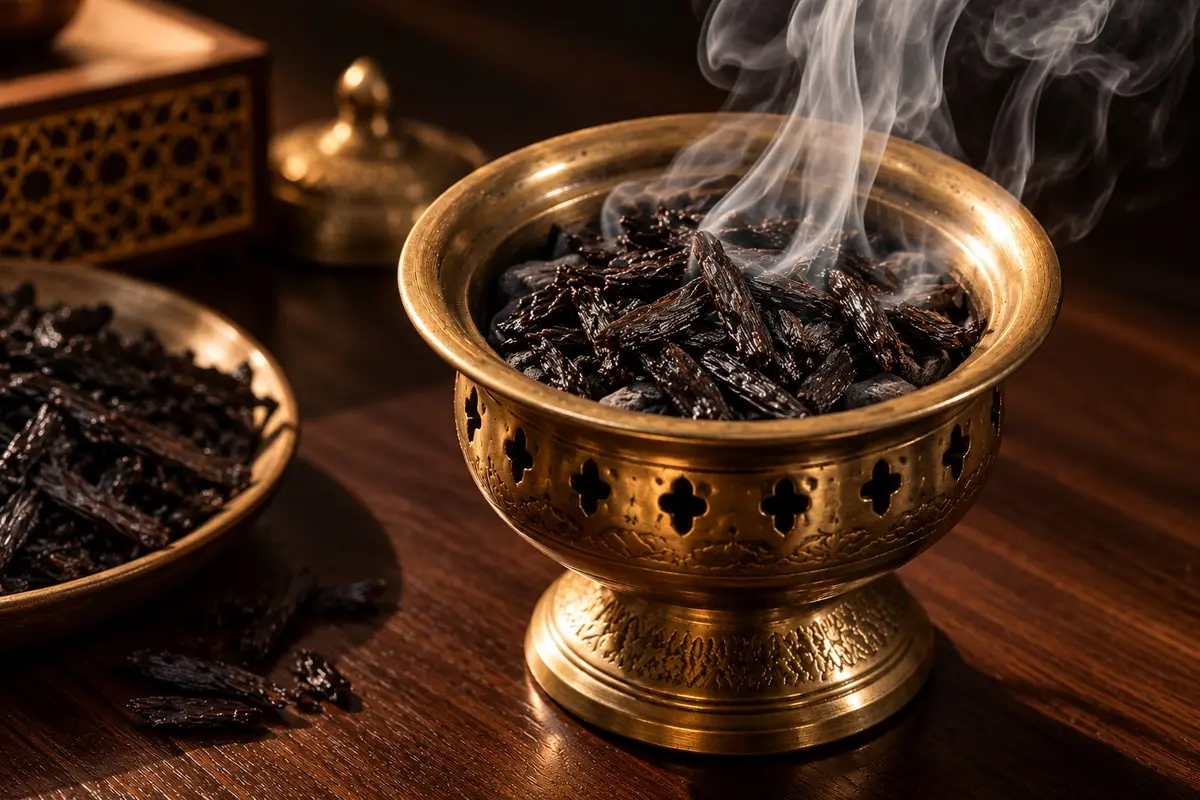
You have probably smelt it before you knew its name. A sweet, smoky warmth at the door of a friend’s home during Eid, or a heavy, woody note drifting through a wedding hall that stayed in your clothes all the way home.
That smell was almost certainly bakhoor. So, what is bakhoor, exactly? It is fragrant wood soaked in oils and resins, warmed slowly so that it releases perfumed smoke. This guide explains what goes into it, where the word and the ritual come from, how it differs from the incense sticks you already know, and what the research says about burning it indoors.
What is bakhoor? Bakhoor is a traditional Arabian home fragrance made from wood chips, usually agarwood (oud), soaked in fragrant oils and bound with resins or sugar. You place it on hot charcoal or an electric burner, and its smoke scents your rooms and clothes. It smoulders slowly rather than burning with a flame.
What Is Bakhoor, in Simple Words?
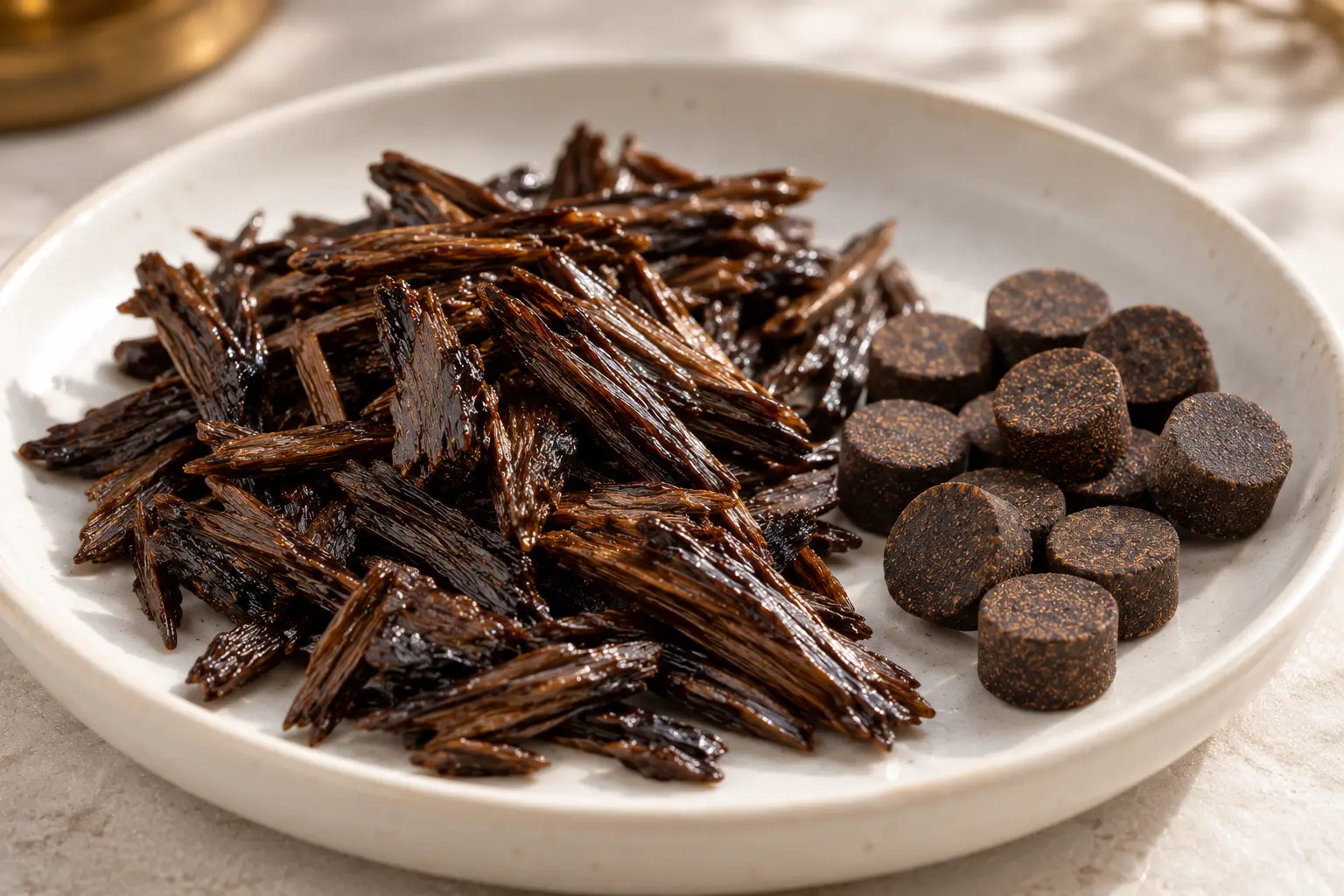
A piece of bakhoor looks like a small dark chip, a pressed tablet or a crumbly brown nugget. It feels slightly sticky or oily to the touch, because it has been soaked in fragrance. On its own it gives off only a faint smell. Place it on something hot and it begins to release thick, perfumed smoke within a minute or two.
That is the key idea behind the question “what is bakhoor”: it is less a product and more a method. Fragrant wood plus heat equals scented smoke. Every recipe, from a family blend in Kuwait to a pressed tablet sold in Hyderabad, follows that same principle.
What Does the Word Bakhoor Mean?
The bakhoor meaning comes straight from Arabic. The word بخور (bakhūr) is linked to the idea of fumes or vapour, and it roughly translates as “perfumed smoke” or “fumigation.”
You will see it spelt many ways in English: bakhoor, bukhoor, bakhour, bukhur and bakhur. They all refer to the same thing. The spelling simply depends on how the Arabic sounds were written down in a given country.
The burner has its own name too.
Mabkhara: the traditional Arabic burner for bakhoor, usually a footed bowl of wood, metal or clay that holds hot charcoal. The name shares the same Arabic root as bakhoor itself.
So when someone asks what is bakhoor in English, the most honest answer is that English has no single word for it. “Incense” comes close, but as you’ll see further down, it misses some important differences.
What Are Bakhoor Ingredients?
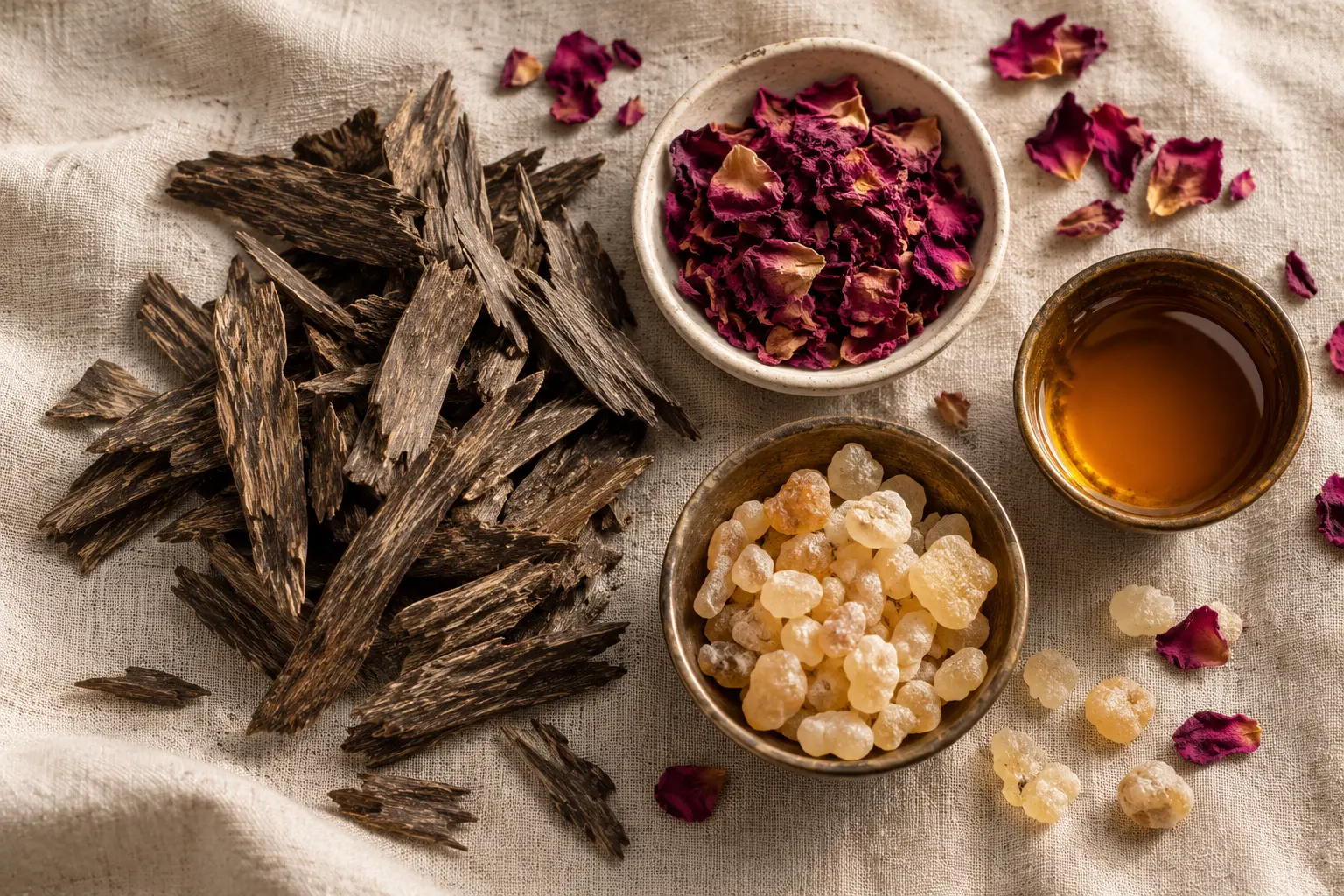
Part of answering what is bakhoor is knowing what’s inside it. The core bakhoor ingredients fall into four groups: a fragrant wood base, scented oils, resins and a binder. Each maker combines them differently, and many families in the Gulf guard their recipes closely.
| Ingredient group | Common examples | What it does |
|---|---|---|
| Wood base | Agarwood (oud), sandalwood | Gives the deep, woody backbone of the scent |
| Fragrant oils | Rose, musk, amber, jasmine, oud oil | Adds the sweet or floral character |
| Resins | Frankincense, myrrh, benzoin | Adds a smoky, balsamic depth and helps it smoulder |
| Binder | Honey, sugar syrup | Holds the oils to the wood so the scent releases slowly |
Some blends also include spices such as saffron or cardamom. Traditional makers often leave the soaked chips to rest for weeks so the oils settle into the wood before it is sold.
Muattar: a word often used for bakhoor chips that have been soaked in perfume oils. In Arabic it broadly means “perfumed.”
The quality of these ingredients varies enormously. Real agarwood is costly, so many affordable blends use cheaper wood dust with synthetic oud oil. Neither is wrong, but the smell and the price will tell you a lot about which one you are holding.
Why Is Agarwood the Heart of Most Bakhoor?
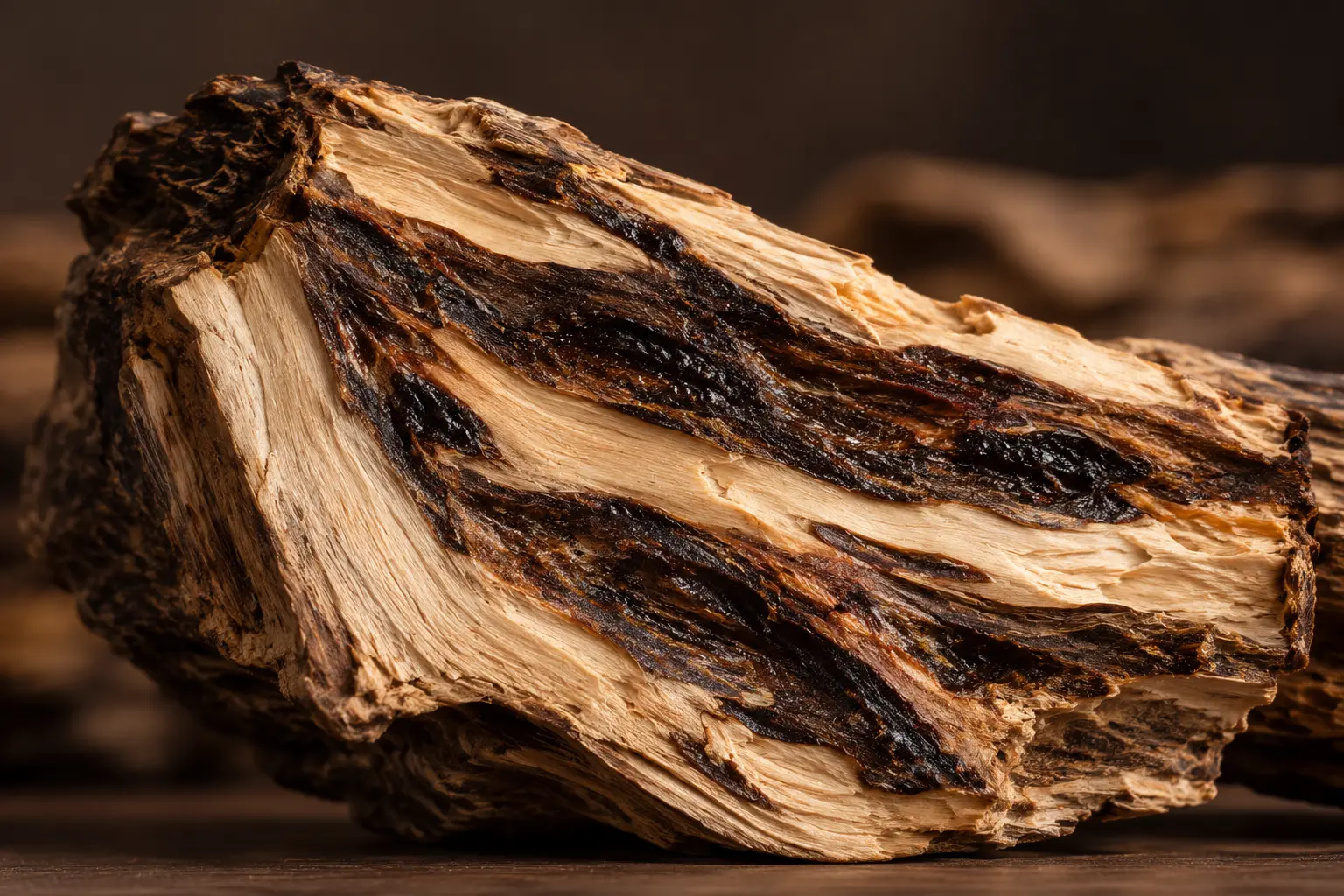
Agarwood gives bakhoor its classic smoky, sweet depth, and nothing else smells quite like it. Most traditional bakhoor is built around it, which is why any answer to what is bakhoor starts with this tree.
Agarwood: the dark, resin filled heartwood of Aquilaria trees, which grow across India, Southeast Asia and parts of China. In Arabic it is called oud.
Oud: the Arabic name for agarwood and the fragrance made from it. The word is used for the raw wood chips, the oil distilled from them and the scent itself.
Here is the surprising part. A healthy Aquilaria tree has almost no smell. According to a 2022 review published in the journal Molecules and archived on NCBI, the fragrant resin forms only when the tree is wounded and infected by fungi, as a defence response. The same review estimates that only around 10% of wild Aquilaria trees ever produce it.
That rarity has a cost. Heavy harvesting of wild trees led CITES, the international treaty that regulates trade in threatened species, to list one agarwood species in 1994 and then every species of Aquilaria and its relative Gyrinops in 2004, as summarised in a CITES report prepared for its 2022 conference. Much of the agarwood traded today comes from trees grown on plantations and deliberately inoculated to form resin.
India has its own place in this story. Assam has a long tradition of agarwood, and researchers there were experimenting with artificial inoculation of Aquilaria as early as the 1950s. Our oud bakhoor guide covers how to tell real oud from synthetic.
What Forms Does Bakhoor Come In?
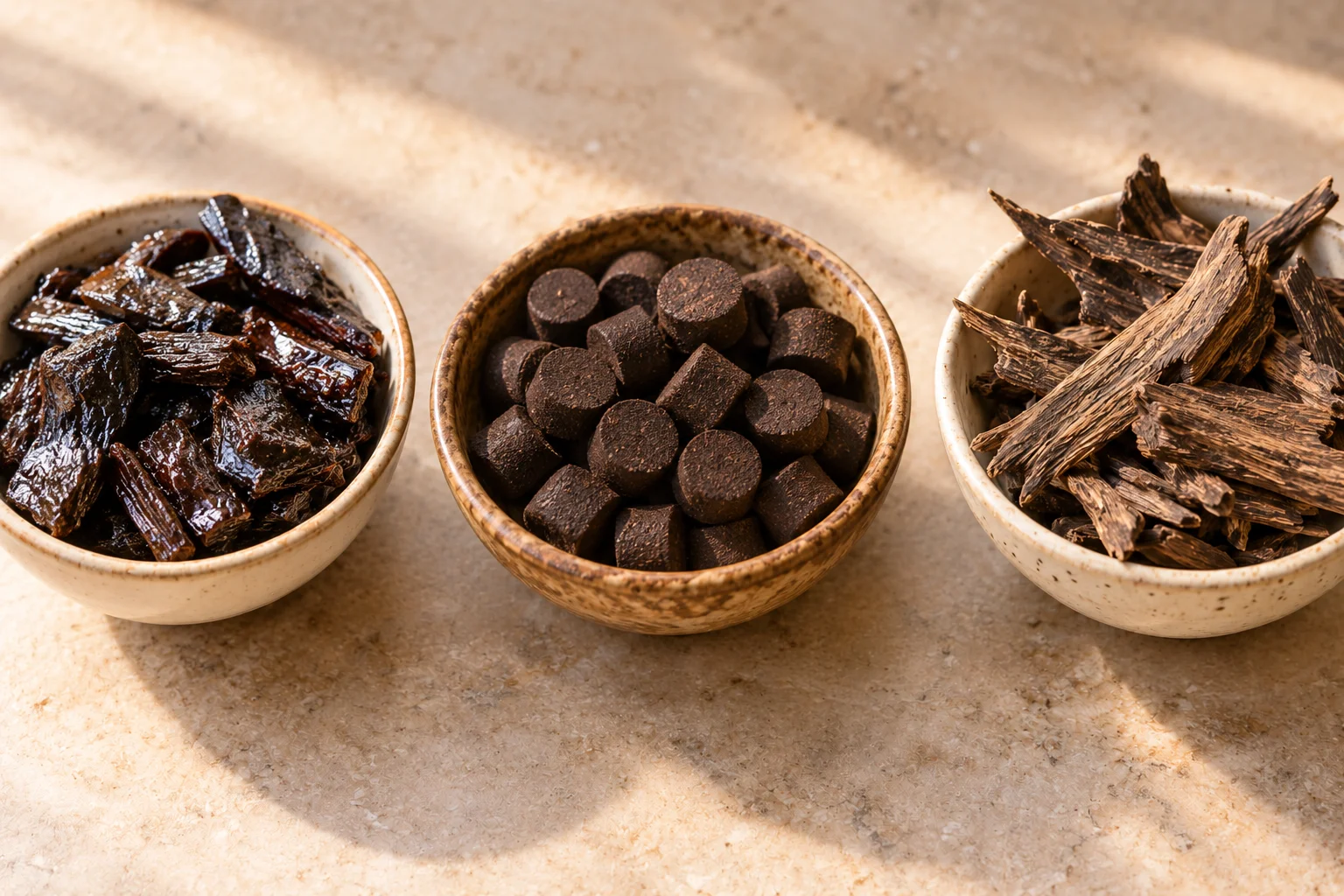
Bakhoor comes in two main forms: loose soaked chips and pressed pieces. A third, simpler option is plain agarwood chips with nothing added.
Soaked chips (muattar). Thin slivers of wood that have absorbed perfume oils. They are usually glossy and slightly sticky, and they release a strong, layered scent quickly.
Pressed tablets or bricks. Powdered wood mixed with oils, resins and a binder, then shaped into small squares, discs or cylinders. They are easy to break into pieces and tend to burn evenly.
Plain oud chips. Pure agarwood with no added fragrance. These smell drier and woodier, and they change character as they heat. Because they rely entirely on the quality of the wood, they are usually the most expensive.
Whichever form you pick, bakhoor is meant to smoulder in small amounts. A useful rule of thumb: soaked chips and tablets are about the blend, while plain oud chips are about the wood.
What Is the Difference Between Bakhoor vs Incense?
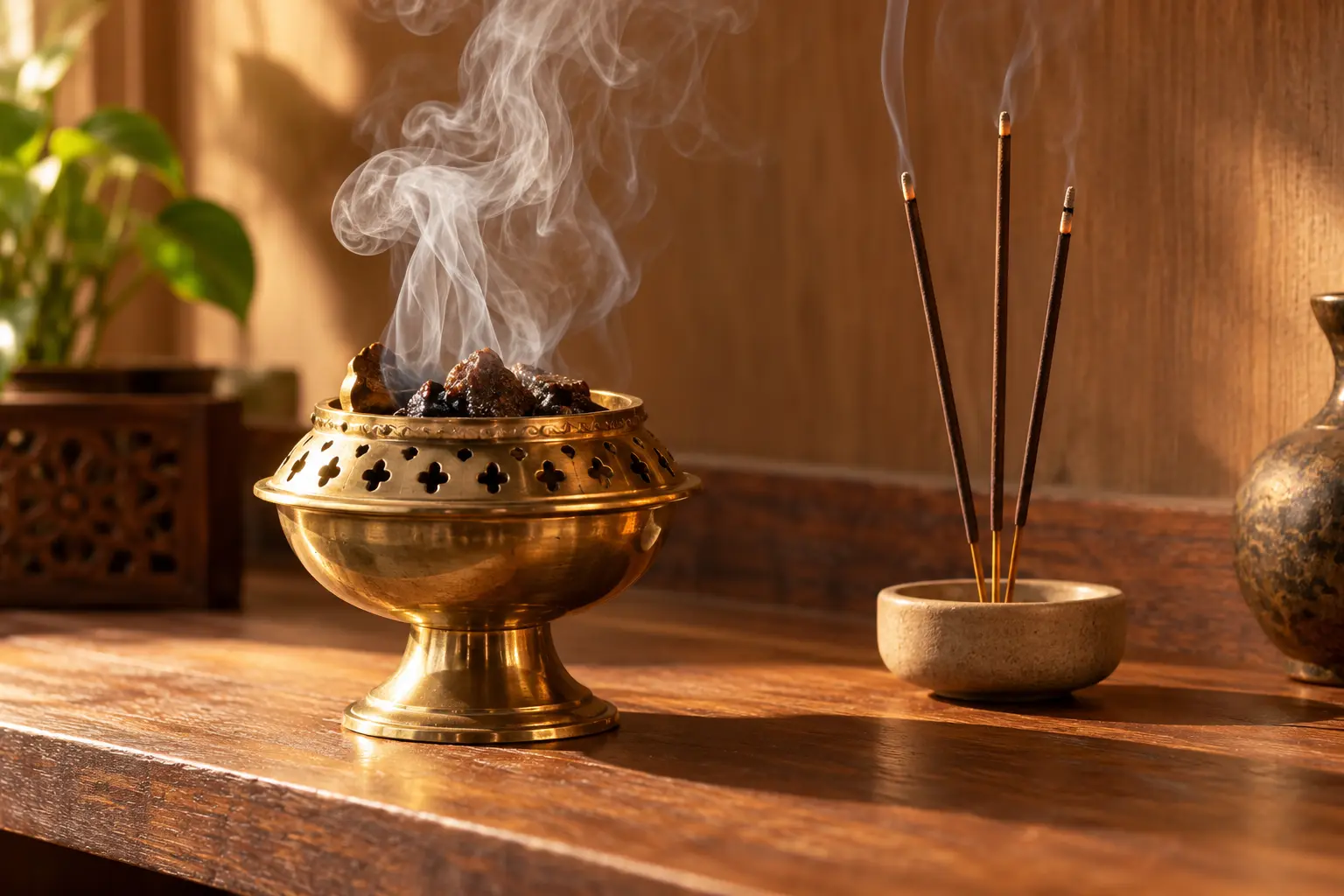
The biggest difference in bakhoor vs incense is how they burn. Incense sticks and cones are lit directly and burn on their own, while bakhoor never catches fire; it needs an outside source of heat to smoulder.
| Bakhoor | Incense sticks (agarbatti) | |
|---|---|---|
| How it burns | Heated on charcoal or an electric burner | Lit with a flame, burns by itself |
| Base | Wood chips soaked in oil | Bamboo stick coated in paste and powder |
| Scent | Rich, oily, clings to fabric | Lighter, fades faster |
| Main use | Scenting rooms, clothes and hair | Prayer, daily freshening |
| Tradition | Arabian Peninsula | South and East Asia |
Indian dhoop and sambrani sit somewhere in between. They are also resin based and smoky, but they tend to smell earthier and less sweet than bakhoor, which leans heavily on perfume oils.
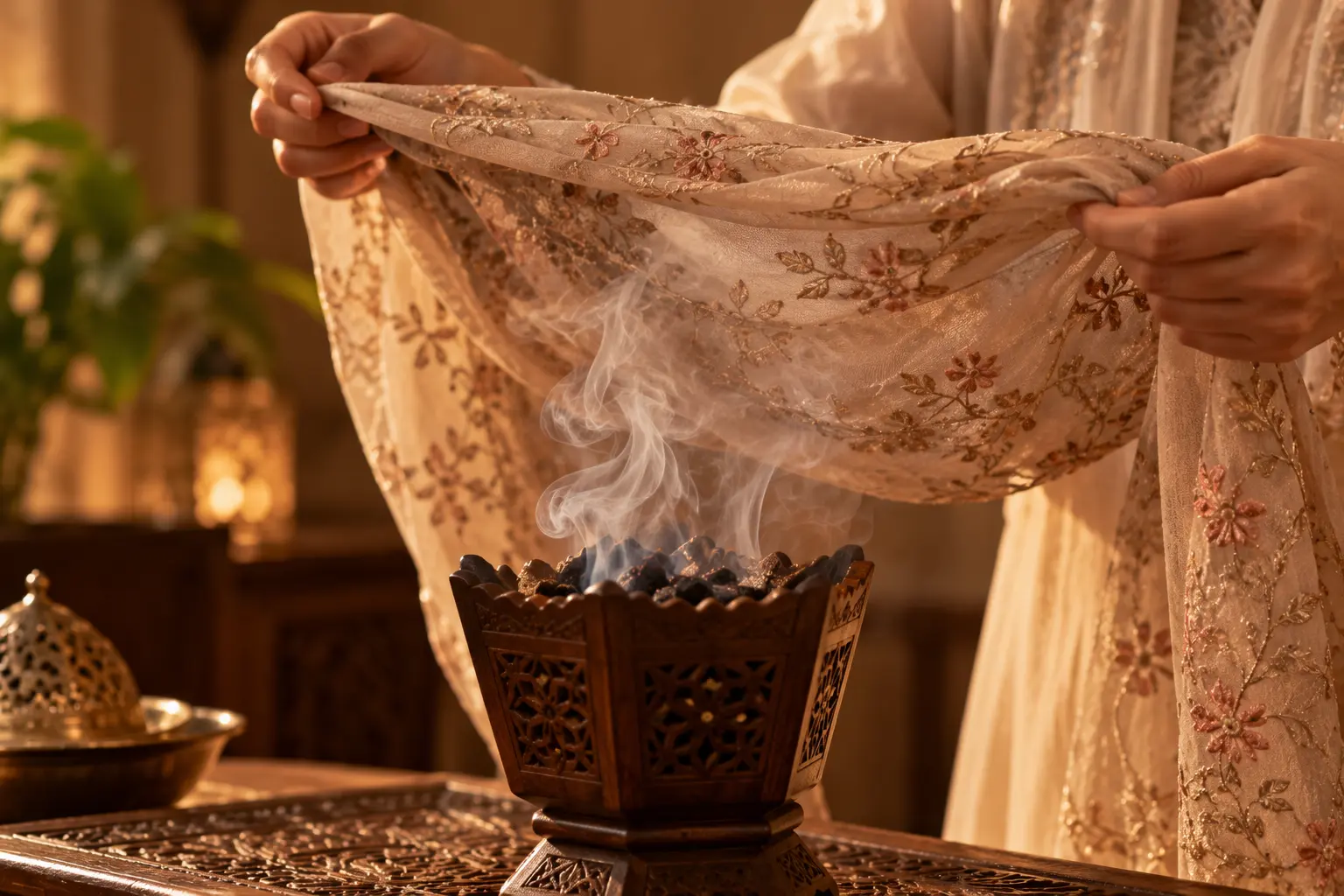
There is a practical difference too. Because bakhoor is oily, its smoke settles into fabric. That is exactly why people in the Gulf hold a dupatta, an abaya or a kandura over the burner before going out, something you would rarely do with an incense stick.
How Do You Burn Bakhoor?
Watch how a charcoal disc is lit and bakhoor is added.
You burn bakhoor by placing a small piece on a heat source, either a glowing charcoal disc in a mabkhara or the hot plate of an electric burner.
- Light a charcoal disc and set it in a heatproof burner.
- Wait until it stops sparking and glows evenly, usually a minute or two. Some people wait a little longer until a light grey coating forms.
- Place one small piece of bakhoor on top.
- Let the smoke rise and drift through the room, or waft it gently towards your clothes.
Bakhoor is just as happy on an electric burner, which skips the charcoal entirely and produces less smoke. That suits flats and daily use. A piece the size of a fingernail is usually enough for a single room.
Tip: If the smoke feels harsh, the charcoal may be too hot. Many people move the bakhoor to the cooler edge of the disc so it smoulders gently instead of scorching.
We cover every method in detail, including smokeless options, in our full guide on how to use bakhoor. For help choosing equipment, see our bakhoor burner guide.
Where Does Bakhoor Come From, and Who Uses It?
Bakhoor comes from the Arabian Peninsula, where burning fragrant wood and resin at home goes back centuries. The region sat on the ancient incense routes, which carried frankincense and myrrh from southern Arabia to Egypt, Rome and beyond.
Today it is woven into daily life across the Gulf. A 2012 study by Karin Yeatts and colleagues, published in Environmental Health Perspectives, found that 86% of Emirati households surveyed burned incense at least weekly and 44% did so every day.
It marks special moments as much as ordinary ones. Here is where you are most likely to meet it:
- Welcoming guests. In many Gulf homes the burner is passed around after a meal, a signal of hospitality and, sometimes, a polite hint that the evening is ending.
- Friday prayers and Eid. Clothes are scented before heading to the mosque, and homes are perfumed for visitors during Eid.
- Weddings. Bakhoor fills entrance halls and is often part of the bride’s preparations.
- Everyday freshening. Many families burn it after cooking to clear food smells.
The practice has travelled well beyond Arabia. You’ll find bakhoor in Muslim homes across India and Pakistan, in East African coastal towns, and increasingly among people anywhere in the world who simply like the smell. For many Indian families, it now sits alongside agarbatti and dhoop around Diwali, weddings and housewarmings.
Is Bakhoor Safe to Burn at Home?
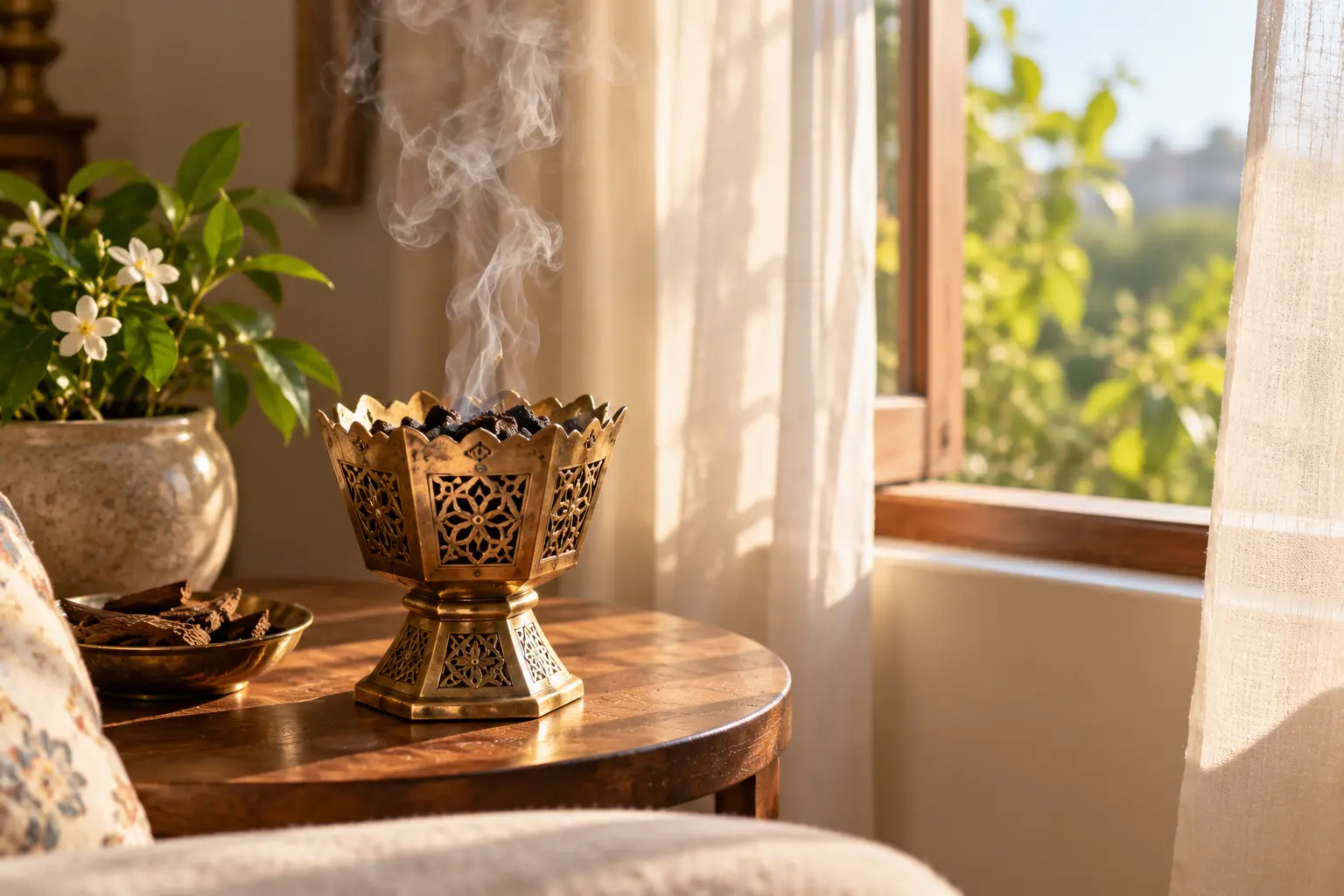
Bakhoor is generally used safely, but its smoke is still smoke, and research shows it affects indoor air. Moderation and good ventilation matter.
A complete answer to what is bakhoor has to include its smoke, and several studies have looked at exactly that. A 2013 UNC study by the Gillings School of Global Public Health found that smoke from Arabian incense triggered an inflammatory response in human lung cells in the laboratory. More recently, a 2026 study in Atmospheric Chemistry and Physics reported that indoor bakhoor burning released large amounts of ultrafine particles, in some measures more than sidestream cigarette smoke in the same test chamber.
That doesn’t mean you need to give it up. It means treating it like any other indoor smoke. These habits help:
- Open a window or keep a door ajar while it burns.
- Use small amounts. One piece is enough. More smoke rarely means more fragrance.
- Never leave it unattended. Hot charcoal can crack a burner or scorch a surface.
- Keep it away from people with asthma, young children and pets, and avoid burning it in a small closed room.
If anyone in your home has a breathing condition, an electric burner with a low setting, or a smokeless alternative, is the gentler choice. When in doubt, ask a doctor.
How Do You Choose Your First Bakhoor?
Start light and simple. Once you know what is bakhoor, picking one is less daunting than it looks. A rose or musk blend is far more forgiving than a heavy oud, especially in a small room.
A few things to look for:
- Smell it cold first. Good bakhoor should smell pleasant even before heating.
- Check the texture. Soaked chips should feel oily, not dry and dusty.
- Be wary of very cheap “pure oud.” Real agarwood is rare and costly, so a very low price usually means a blend with synthetic oil.
Honestly? Bakhoor is personal, and the best bakhoor is simply the one you enjoy in your own space. A scent that feels perfect in a large Gulf majlis can be overwhelming in a city flat.
Frequently Asked Questions
What is bakhoor made of?
Bakhoor is usually made of wood chips, most often agarwood or sandalwood, soaked in fragrant oils such as rose, musk or amber. Resins like frankincense are often added, and honey or sugar binds everything together. Many blends rest for several weeks so the oils settle into the wood.
What is bakhoor used for?
Bakhoor is used to scent homes, clothes and hair. People burn it to welcome guests, prepare for Friday prayers and Eid, perfume wedding venues and clear cooking smells. In the Gulf, holding clothes over the smoke before going out is a daily habit for many.
What is bakhoor in English?
There is no exact English word for bakhoor. It is often called Arabian incense, and the Arabic word roughly means perfumed smoke. Unlike incense sticks, though, it does not burn on its own and needs charcoal or an electric burner.
Is bakhoor the same as oud?
No. Oud is agarwood, a fragrant resin filled wood, while bakhoor is a preparation that often contains oud alongside oils, resins and binders. You can burn plain oud chips the same way you burn bakhoor, but not all bakhoor contains real oud.
Is bakhoor the same as agarbatti?
No. Agarbatti is a bamboo stick coated in fragrant paste that you light with a flame and leave to burn by itself. Bakhoor is oil soaked wood that only smoulders when placed on a heat source, and its scent clings to fabric much longer.
Is it safe to burn bakhoor every day?
Many households burn bakhoor daily, but studies show its smoke adds fine particles to indoor air. If you use it often, keep a window open, burn only small pieces and avoid closed rooms. People with asthma or other breathing conditions should be especially careful.
Can you burn bakhoor without charcoal?
Yes. An electric bakhoor burner heats the chips on a hot plate, so you don’t need charcoal at all. It produces less smoke and is easier to control, which makes it popular in flats and offices.
How long does the smell of bakhoor last?
In a room, the scent usually lingers for a few hours after the smoke clears, depending on ventilation and the blend. On fabric it can last much longer, often until the clothes are washed, because the oily smoke settles into the fibres.
What is bakhoor called in Hindi?
There is no traditional Hindi word for bakhoor, so most people in India simply use the Arabic name. It is sometimes loosely grouped with dhoop or sambrani, but those are resin based and earthier, while bakhoor is wood soaked in perfume oils.
Why is real oud bakhoor so expensive?
Real oud comes from agarwood, which forms only when an Aquilaria tree is wounded and infected by fungi. Research suggests only around 10% of wild trees produce it, and international trade is regulated under CITES. That scarcity makes genuine oud one of the costliest fragrance materials in the world.
So, What Is Bakhoor Really?
At its simplest, bakhoor is fragrant wood that turns heat into scent. Behind that simple idea sits a rare tree, a centuries old trade route and a ritual of hospitality that stretches from Gulf homes to wedding halls in India.
Now that you know what is bakhoor and what goes into it, the next step is learning to burn it well. Start with our guide on how to use bakhoor.
Leave a Reply